


ITHACA, N.Y. (NCC News) — Students, faculty members and community members gathered at Cornell University Monday, Oct. 5, for the “Justice for Survivors” protest, calling for changes to how the university handles sexual assault cases and for accountability from university leadership.
The protest was organized by Students for a Democratic Cornell and other student organizations. It began at 4:30 p.m. Monday at Ho Plaza.
The demonstration comes amid renewed attention to a case involving a former Cornell student identified in court documents as Jane Doe and seven former members of the Chi Phi fraternity.
Doe alleges she was drugged with ketamine and sexually assaulted by multiple Chi Phi members at the fraternity house in October 2024, according to a civil lawsuit filed against Cornell, Chi Phi and the seven former members. Doe also alleges Cornell failed to properly respond to the allegations.
Doe has requested to remain anonymous in court filings, citing concerns about retaliation and damage to her reputation.
Cornell investigated the allegations through its Title IX and student conduct processes. Cornell said the case resulted in disciplinary sanctions that included expulsions and suspensions. It also said that the Chi Phi chapter was shut down, according to a Sept. 28, 2026, statement.
Cornell also disputed claims that essays were the sole consequence for students involved.
“Any suggestion that the university did not impose consequential punishments for those involved is false,” wrote Kyle Kimball, vice president for University Relations, in the Sept. 28 statement.
The seven former Chi Phi members named in the lawsuit have not faced criminal charges, according to the Sept. 28 statement from the Tompkins County district attorney’s office.
In the statement, the district attorney’s office said Jane Doe’s sworn statement to Cornell University Police in November 2024 did not allege that she was drugged against her will or gang raped. The office said her statement described her participation in drug use and sexual conduct as voluntary, conscious and consensual.
The criminal investigation was reopened Sept. 28, 2026, according to the Tompkins County district attorney’s office. New York Attorney General Letitia James was appointed special prosecutor Oct. 1 according to the New York attorney general’s office.
A special committee of Cornell’s Board of Trustees announced Oct. 6 that it retained former U.S. Deputy Attorney General Sally Yates to lead an independent review of how the university prevents and responds to sexual harassment, sexual assault and related misconduct. The review includes a detailed look at the university’s response to the allegations involving Jane Doe and members of the Chi Phi fraternity in October 2024, according to a statement from Cornell.
Student organizers called for Cornell to expel or revoke the degrees of those they say were involved in the alleged assault. They also called for mandatory sexual assault prevention training for students and trauma-informed training for Cornell University Police, an external investigation into the university’s handling of the case and a return to a university-wide judicial system independent of the administration. Organizers also called for changes to Cornell’s Policy 6.4, which addresses sexual misconduct.
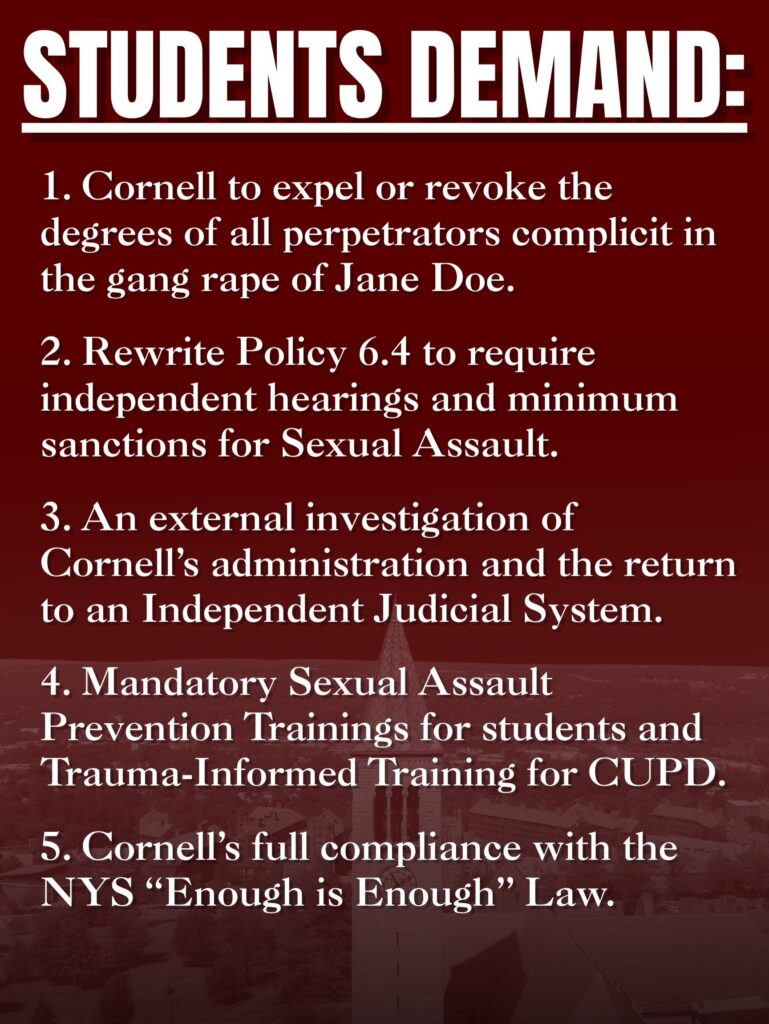
Student organizers then took the microphone to address the crowd, saying, “We won’t stand for Cornell’s corruptness any longer.” They told the crowd, “Students before us have faced disappointment with this university and refuse to let disappointment be the end of their story,” and, “We demand expulsion or revocation of all the Chi Phi brothers involved in the rape of Jane Doe.”
Demonstrators also chanted, “No justice, no peace.”
Signs throughout the crowd included messages such as “Stop Rape Culture,” “Justice for all Jane Does,” “How Many More?” and “No Essays for SA.”
“Jane Doe” name tags were distributed by members of the group to represent solidarity with the woman at the center of the case.
Some attendees also wore purple ribbon pins.
“So this pin is for awareness of sexual violence. Obviously this is very much something that is going on campus, going on well everywhere around the world,” Cornell senior Isabel Breslin said.
The protest was not limited to students.
Ithaca residents also attended the demonstration. Stephanie R., who did not want to share her last name, said she attended the protest to support Cornell students and faculty.
“I wanted to support Cornell students and faculty that are looking for the honest truth and to get some sort of change,” Stephanie said.

About 40 student organizations helped organize the rally, as reported by The Cornell Daily Sun. The newspaper reported that thousands of students, faculty members and Ithaca community members attended the protest.
Earlier Monday, Oct. 5, Day Hall, Cornell’s main administration building, was vandalized. A glass door was damaged and red graffiti was painted on the building, including messages reading “Smash the patriarchy” and “At Cornell rapists are protected protestors are expelled.”
Cornell said in an Oct. 5 statement that it was investigating the vandalism and condemned the property damage. NCC News reached out to Cornell University Police for comment on the investigation Tuesday, Oct. 6, and had not received a response as of publication.
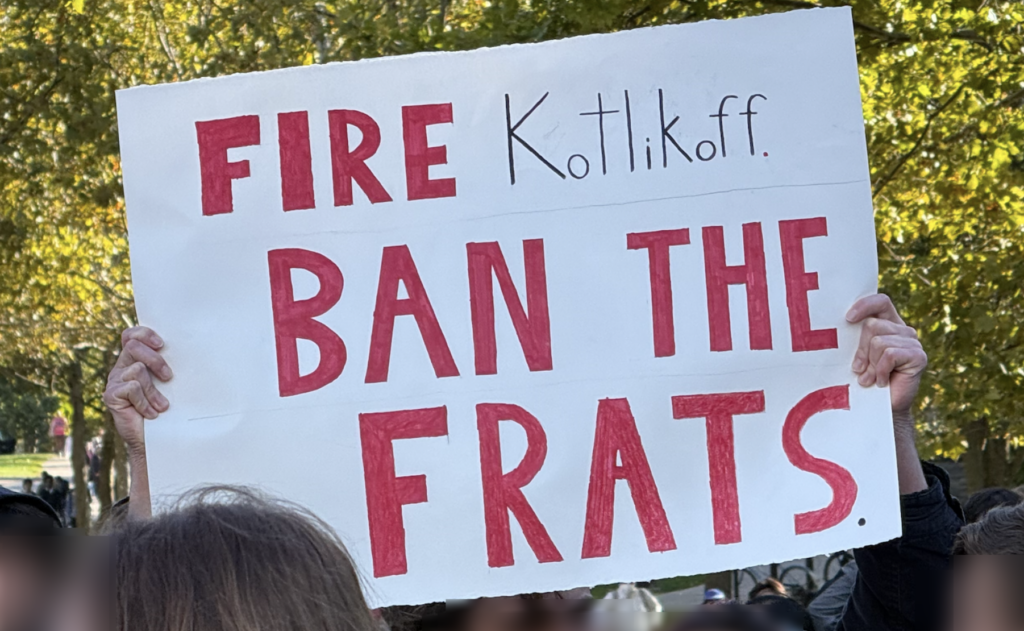
Along with demanding justice for Jane Doe and other survivors of sexual assault, protesters also called for Cornell President Michael Kotlikoff to resign.
One sign held by a demonstrator read, “Fire Kotlikoff Ban the Frats.”
Public policy major Grady Pomerantz, a freshman, said he believes some responsibility lies with New York state law.
“I’m more hesitant to put the burden of responsibility on the school than on state law and what those requirements really should be,” Pomerantz said.
New York law addresses consent and incapacity in separate places. The state’s education law sets requirements for how colleges handle consent in their conduct codes, and its penal law defines terms used in sex offense cases.
New York Education Law § 6441 requires colleges and universities to adopt a definition of affirmative consent in their codes of conduct. The law states that consent is required regardless of whether the person initiating sexual activity is under the influence of drugs or alcohol. It also states that consent cannot be given when a person is incapacitated and that, depending on the degree of intoxication, someone under the influence of alcohol, drugs or other intoxicants may be incapacitated and unable to consent. The law directs institutions to reflect these principles in their codes of conduct.
New York Penal Law § 130.00 defines “mentally incapacitated” for purposes of the state’s sex offense laws. The law says a person is mentally incapacitated when they are temporarily incapable of appraising or controlling their conduct because of a narcotic or intoxicating substance administered without their consent, or because of any other act committed on them without their consent.
The group is planning a seven-hour sit-in Wednesday, Oct. 7. Faculty members are also preparing for a no-confidence vote related to the administration’s handling of the case, reported by CNY Central.
NCC News contacted Cornell administration by email Tuesday, Oct. 6, for comment. The administration referred NCC News to its previous public statements. NCC News also contacted the Cornell president’s office and Chi Phi representatives Tuesday, Oct. 6, for comment and had not received a response as of publication.