

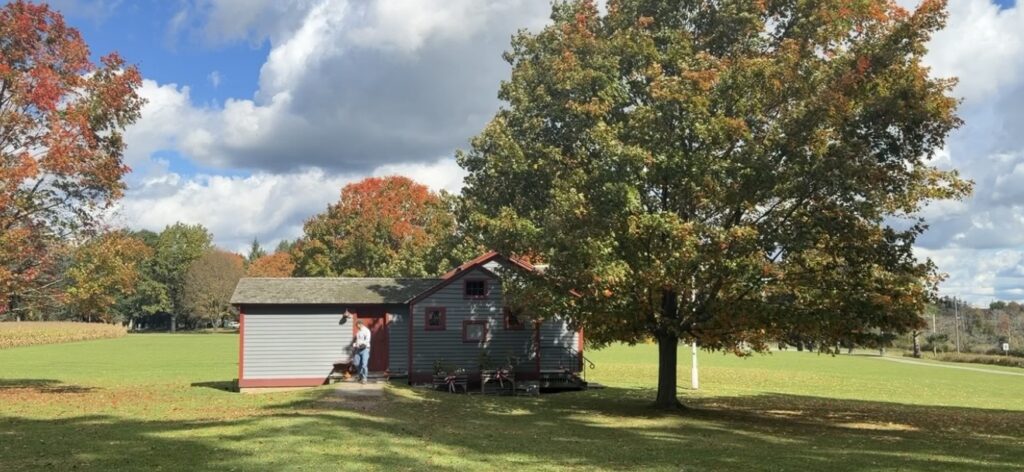
CAZENOVIA, N.Y. (NCC News) — A school day in Cazenovia looked different in 1887. Students of different ages shared one classroom, learned from one teacher and took an hour-long lunch break known as “nooning.” Today, visitors to the Rippleton Schoolhouse can experience that history firsthand.
Alison Boissonnas portrays Maddie Buckland, the schoolmistress who taught at the school in 1887. Through immersive lessons, she helps visiting students experience the classroom as children would have more than a century ago.
Boissonnas researched Buckland’s life and contacted her descendants to better understand the woman behind the role. She said she encourages students to take a similar approach as they prepare for their visits.
“Some of them have even written backstories on their historical research, which I think is fascinating,” Boissonnas said.
During their lessons, students practice reading, writing and arithmetic, along with recitation, just as children did in the 19th-century classroom.
The school day itself had some similarities to modern schedules. Classes typically ran from about 9 a.m. to 3 p.m., but the school calendar reflected the needs of the surrounding farming community. Students often had extended breaks during planting and harvesting seasons to help their families.
The Rippleton Schoolhouse served District No. 7 of 23 school districts in Cazenovia. Students in first through eighth grade learned together in the same room under one teacher. Enrollment depended on the number of children living nearby. Some one-room schoolhouses held 20 students or fewer, while others had more than 100.
By 1887, New York state required children to attend school, but the mandate had not been in place for long. Some students came from families whose parents had never attended school themselves.
The Rippleton Schoolhouse dates to 1814 and underwent remodeling in 1884. The Friends of Lorenzo restored the building to reflect its 1880s appearance and moved it to the grounds of Lorenzo State Historic Site in 1997. Today, it serves as an interpretive center where students and other visitors explore local history through hands-on activities.
Fourth graders often visit because New York students study state history at that age. Boissonnas said the schoolhouse helps students connect with the past in ways that textbooks alone cannot.
“Teaching history to students is complicated,” Boissonnas said. “And any tools that we can use that can make it more relatable are useful.”
Students can touch objects, walk across the floor and hear the sounds of doors and windows built hundreds of years ago. Boissonnas said these experiences encourage students to ask questions they might not think of in a modern classroom.
The lessons also introduce students to the changing opportunities women had in education. Buckland attended what is now SUNY Oswego to earn her teaching credentials and continued her education at Yale and Syracuse University.
Buckland’s background reflects a period when women had more opportunities to pursue formal training as teachers rather than entering the profession without specialized preparation.
Boissonnas said she finds that shift particularly interesting because teachers could study subjects beyond the traditional three R’s, including music, science and foreign languages.
The schoolhouse also creates opportunities to discuss parts of local history that visitors may not expect. Boissonnas said Cazenovia was more diverse than people might assume.
Those conversations matter because students arrive with their own questions and perspectives, Boissonnas said. She said she wants the schoolhouse to remain a place where they can raise those questions and explore history beyond the familiar stories.
Paul Nasca, the historic site manager at Lorenzo State Historic Site, said preserving places like Rippleton helps the community understand how its past shaped its present.
“I think history is important to preserve because it’s a continuum and we all are a part of that continuum,” Nasca said.
Lorenzo State Historic Site preserves 86 acres of the original 600-acre tract associated with Cazenovia’s founding. The site also hosts community events, including performances by the Syracuse Orchestra and a horse-and-carriage driving competition.
For Boissonnas, however, the schoolhouse comes to life when students arrive and begin asking questions.
“The conversations with the kids, hands down,” she said when asked about her favorite part of portraying Buckland. “It’s a wonderful building, and it’s fun to hang out here, but it really comes to life when the children walk in.”