

© 2026 U.S. Department of War
SYRACUSE, N.Y. (NCC News) – The federal government released its third batch of declassified files on unidentified flying objects last week.
On June 12, the Pentagon posted 72 files on what it now calls unidentified anomalous phenomena, or UAP, the government’s preferred term for what the public still calls UFOs. The release, part of a disclosure program known as PURSUE, included eyewitness videos, decades-old classified reports, NASA audio, and a Pentagon report that says a significant share of the cases it reviewed still cannot be explained. It was the third such release in about five weeks, and the website where the files are posted has logged more than 1.7 billion visits since it launched in May, according to the Department of War.
To find out whether anyone here was paying attention, NCC News asked people around Syracuse what they made of it. Most had not heard about the release at all. The ones who had, landed in very different places.
Matt, an SU student who described himself as a skeptic, was not convinced there was much to it. He had not given the subject a lot of thought, he said, because it seemed “so not serious.” His reasoning was straightforward: if there was really something to the files, the news would be paying far more attention to it, and since he had not heard much, he assumed there was not much there. He was not ruling out life elsewhere, though.
“There’s probably other life in the universe, but probably not aliens coming to visit us,” he said.
Others had moved further. One Syracuse resident, John Sheriff, said some of the video had genuinely unsettled him.
“It’s tough to think now, because I’ve seen the videos, and it definitely looks like not something human-made, which is kind of scary,” Sheriff said. He also found it hard to rule out life elsewhere.
“To think we’re the only lifeform anywhere in the universe, I think that’d be a little foolish,” he added.
Asked about the theory that the government is releasing the files to distract from other issues, Sheriff did not dismiss it, but he did not fully buy it either.
“I think that’s possible,” he said. “But also, I think they really couldn’t ignore the videos going out. At some point, you have to talk about it. So I think maybe a mix of both.”
A third resident, Jeff, needed only a sentence. “There’s something else out there,” he said.
“Hard to believe it’s just us,” he said. “I’m not going to say there isn’t something else.”
That range, from a skeptic who trusts that real news would surface on its own, to a resident who finds the footage frightening, to one who simply assumes we are not alone, is part of what makes the topic different from what it was a generation ago, when admitting you took UFOs seriously was a fast way to get laughed at.
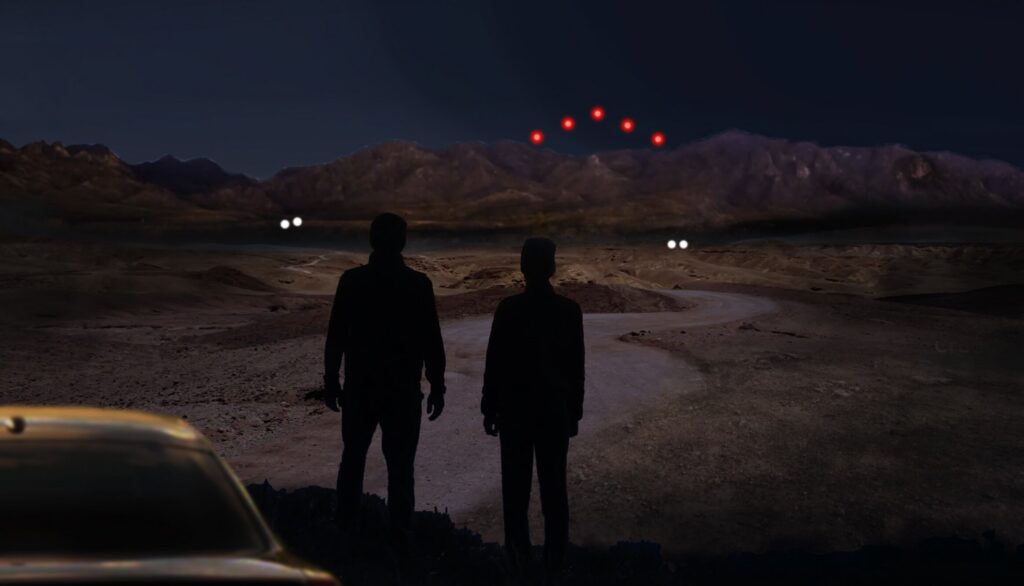
The files themselves are a mix of the dramatic and the inconclusive. The central document in the latest release is a report dated June 5 from Jon Kosloski, director of the Pentagon’s All-Domain Anomaly Resolution Office, the unit tasked with investigating the cases. The report describes an encounter involving an orange “mother” orb that appeared to release smaller red orbs, and concludes that roughly 40% of the phenomena it reviewed could not be tied to a conventional explanation.
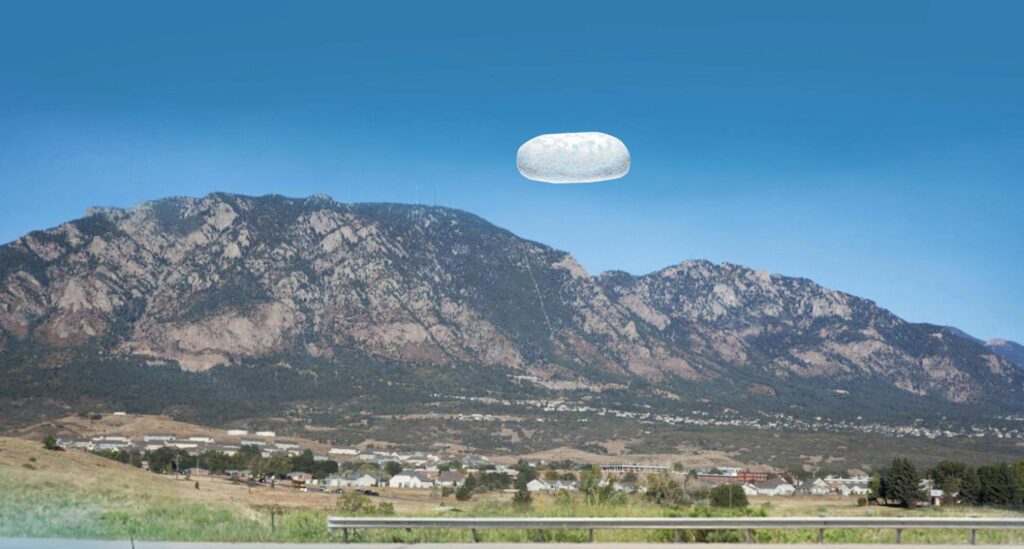
Other documents reach back years. In 2022, five soldiers near the Cheyenne Mountains outside Colorado Springs, Colorado reported watching a white, potato-shaped object hover in broad daylight before it vanished. According to the files, the witnesses independently drew matching pictures, and an internal assessment that floated sunlight on snow as an explanation was logged with “low confidence” by its own authors.
What the files do not include is proof. There is no recovered craft and no physical material. Several of the images in the release are not photographs but artists’ recreations based on witness accounts, and the government describes every case as unresolved.
That distinction is one experts stress: “unexplained” is not the same as “extraterrestrial.” Past Pentagon reviews of more than 1,600 cases have found that the overwhelming majority of sightings turn out to be ordinary objects, balloons, drones, commercial aircraft or sensor errors, with no evidence of alien technology.
For a scientific perspective, NCC News reached out to Avi Loeb, who agreed to let the station quote his published analysis. Loeb is the Frank B. Baird Jr. professor of science at Harvard University and the former chair of its astronomy department. He directs the Galileo Project, a scientific effort to study anomalous objects using instruments rather than eyewitness accounts, and he chairs a science council advising the federal government on the subject.
He argues consistently that only hard data, not belief, can settle the question. In an essay published the day of the release, Loeb called it the most intriguing batch of files so far, while underscoring its limits.
“Clearly, more data needs to be collected and analyzed in order to figure out the origin of these Unidentified Anomalous Phenomena,” he wrote.
Of the broader phenomenon, Loeb has written that it points to one of two conclusions: “either a serious breach of national security, or the biggest discovery in human history.” Both, he notes, would demand the physical evidence that the files so far have lacked.
The timing of the releases has drawn its own scrutiny, the question Sheriff raised. They are arriving quickly, three in about five weeks, under a transparency directive issued by the Trump administration earlier this year, and some observers have wondered whether the steady stream of dramatic, easily shared material is partly meant to capture public attention.
Whatever the motivation, the strongest cases in the public record have tended to be the ones backed by more than a single witness. The 2004 encounter between Navy pilots and an object off the coast of California, tracked on radar, captured on a fighter jet’s infrared camera, and seen by trained aviators, remains the most cited example. The Pentagon has confirmed that the footage is authentic.
The Pentagon says additional files will be released on a rolling basis. And the scientists studying the objects are now also studying how the public is reacting to them. Loeb’s team has launched an anonymous public survey on attitudes toward UAP, non-human intelligence, and the PURSUE disclosure effort, work he says will feed peer-reviewed research and recommendations on future government transparency.
For now, the answer remains unresolved. The files are real, and a handful of cases are genuinely unexplained, but there is no proof of anything beyond that. What has changed is the reaction on the street, where the reflexive laugh is getting harder to find.