

POMPEY, N.Y. (NCC News) — Take a drive on I-81 southbound leaving Syracuse. Once the congestion of the I-81 Viaduct Project clears out, the hills of Central New York open up. Along the scenic drive stand town markers: Homer, Virgil, Marathon, Pompey — the list goes on.
The names of these places have their roots in antiquity, and the inspiration for them can tell a lot about American history.
The town of Pompey is spread out across rolling hills, its center just a few buildings on a country road. Town historian Ruth Hotaling has lived here her entire life.
“I’ve had people from Texas tell me, ‘Oh, the hills are beautiful, but this is the best kept secret in the United States, it’s absolutely beautiful here!'” said Hotaling.
The town is named after the Roman general Pompey, the man who ruled with — and ultimately fought against — Julius Caesar. Why, though, is a town in Central New York named after a more than 2,000-year-old Roman general? The answer dates back to the aftermath of the Revolutionary War.
“It’s part homage, it’s part creation of this revolution that gives birth to this independent republic of these United States,” said Robert Searing, Curator of History at the Onondaga Historical Association in Downtown Syracuse (which also gets its name from a Sicilian coastal city).
Mounted on the wall of his cluttered office is a map of Central New York, divided up in large squares. Those squares belong to the Central New York Military Tract — the newly-formed American government’s solution to paying its soldiers. The government did not have the money to pay soldiers outright, so it divided up what it considered “empty” land in CNY, depiste the facts it was already inhabited by the Haudenosaunee, and awarded it to soldiers.
“It was wilderness during the Revolutionary War; we were the Western Frontier – we were the West!” said Hotaling.
Those in charge of naming the new settlements leaned on their education; the leaders of the 18th century were taught the classics and studied Antiquity — that education reflects in the names across Central New York.
“People name places because it has a significance to them,” said Searing.
But the land claimed for new settlements had been home to the Haudenosaunee for generations.
“[The Central New York Military Tract] does not exist without the dispossession of these lands from the Haudenosaunee Confederacy, which had controlled this particular landmass for at least a thousand years, most likely two millennium and beyond that,” said Searing.
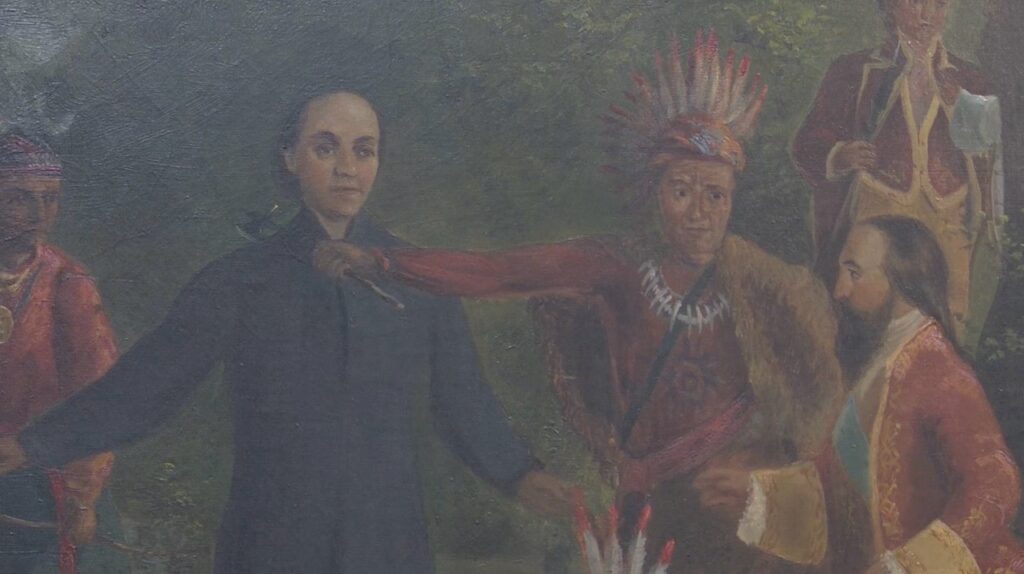
The campaigns to push them off the land were brutal and bloody. Many of the Haudenosaunee fought on the side of the British during the Revolutionary War, and some of the largest offensive movements of the war came as part of campaigns against Native Americans.
“There is no expansion of the State of New York without the dispossession of the Haudenosaunee,” said Searing. “What you see in the naming of those towns and villages is the erasure of Indigenous history and its replacement.”
The history of these towns serves as a microcosm of the history of the United States — both told in victory, and in those displaced because of it.
“The idea that these issues are still omnipresent and still with us and still affecting the lives of people 250 years later, I think is something most folks do not think about when they drive through Marcellus or take a trip out to Pompey,” said Searing.
Searing stressed that America’s revolutionary history is complex and multifaceted, and it is important to understand the whole of the U.S.’s actions.
Central New York is home to a vital piece of American history — shown in the names along I-81, and in those erased from the history books.