

SYRACUSE, N.Y. (NCC News)—The “American Dream” is facing a harsh reality check. For decades, the United States has served as the premier destination for global scholars, currently hosting 1.2 million international students, which accounts for 6% of total U.S. higher education enrollment. However, that pipeline is shrinking. According to the Open Doors, a project is sponsored by the U.S. Department of State, new international student enrollment for the fall of 2025 fell by 17% compared to 2023.
But behind the numbers are people with stories who have a goal here in the U.S. One of them is a Indian graduate student at Syracuse University. “The American Dream was mostly the reason why I decided to do master’s in the first place”, she says.
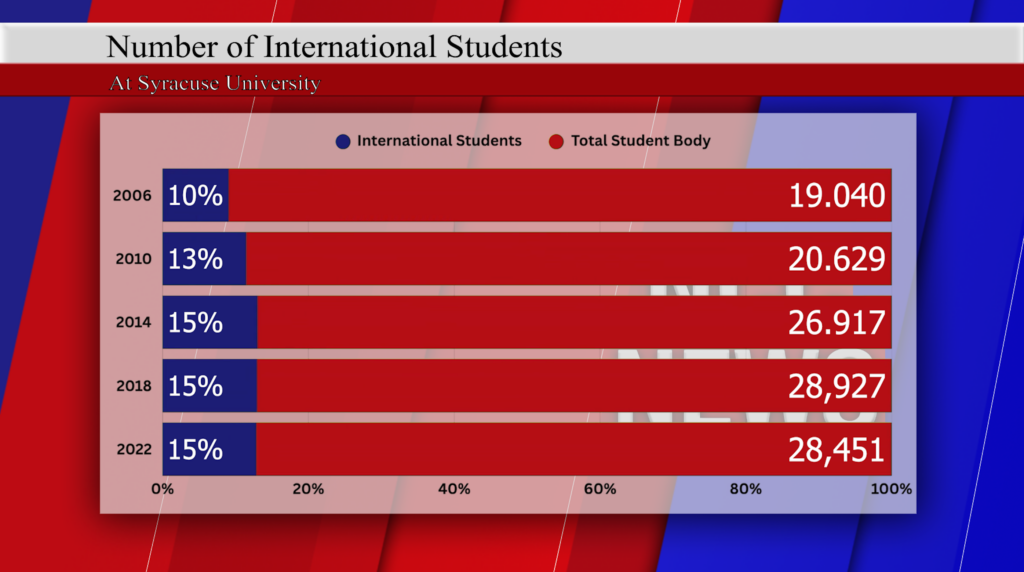
However, fewer and fewer international students are making this decision. At Syracuse University the decline is felt too. While international students had consistently accounted for 15% of the total student body since 2014, this figure changed drastically last year. According to Syracuse.com, former SU Chancellor Kent Syverud reportedly stated at the University Senate meeting in September: “In the fall of 2023, 12% of incoming undergraduates were international students. This fall, that number plummeted to 5%.”
The Financial Gamble
For students like the master’s student from India, pursuing a degree is more than just an academic decision—it’s also a major financial one. With undergraduate tuition set at $66,580 per year, a single student can pay a university up to $300,000 in tuition and fees over the course of four years. “It was a big financial decision, yes.”. For her and her family, therefore, the return on investment is also a key factor and a source of hope in their decision to pursue this degree program in the United States. “Eventually, if I’m not making that money back, it’s going to be a huge void financially for my family too”.
International graduates have 90 days after graduation to find a job— a clock that counts down the chances of earning back the money invested in their studies. “That clock, every day it’s minus one day, minus two day, so that clock is always ticking.” And finding that job turns out to be a major challenge. “There’s just one question that everyone is just so tired of answering whenever we fill out a job application. There’s this question that we have to answer, will you require sponsorship now or in future? And we have to click yes, because eventually we will need that in future, but we don’t need it right now.”
What the master’s student is referring to is the one-year Post-Completion Optional Practical Training (OPT) during which they do not need a work visa. Eligible STEM graduates even can extend this to three years. However, after this, they need an H-1B visa, a non-immigrant, employer-sponsored visa which comes with an $100,000 fee—and this is what deters small and medium-sized businesses in particular.
Strategies for Resilience and Community
“Honestly, crossing oceans coming here, everything is just so different. So there’s nothing really left here to call home. Everything is just so different.” A first step to creating a sense of belonging while living abroad often starts with actively building a community that celebrates your shared cultural roots. “We celebrate as many festivals as we can. Everyone is from a different region in India and every region in India has a different festival. We celebrate all of those. And sometimes we would also get to wear our own traditional clothes. We would talk to each other in our own language, sing Bollywood songs, dance to Bollywood music and then just celebrating festivals together. That really helps.”
Beyond cultural connection, building a resilient mindset is just as important since it is easy to feel overwhelmed by external pressures like visa policies or unpredictable job markets. Sociology Professor Yingyi Ma therefore offers the following advice: “Do not obsess with the news cycle too much, recognize things under your control and things beyond your control, and focus your energy on things under your control.” A good advice—whether you’re an international student or not—that might also inspire to make a difference in the little things in everyday life.