

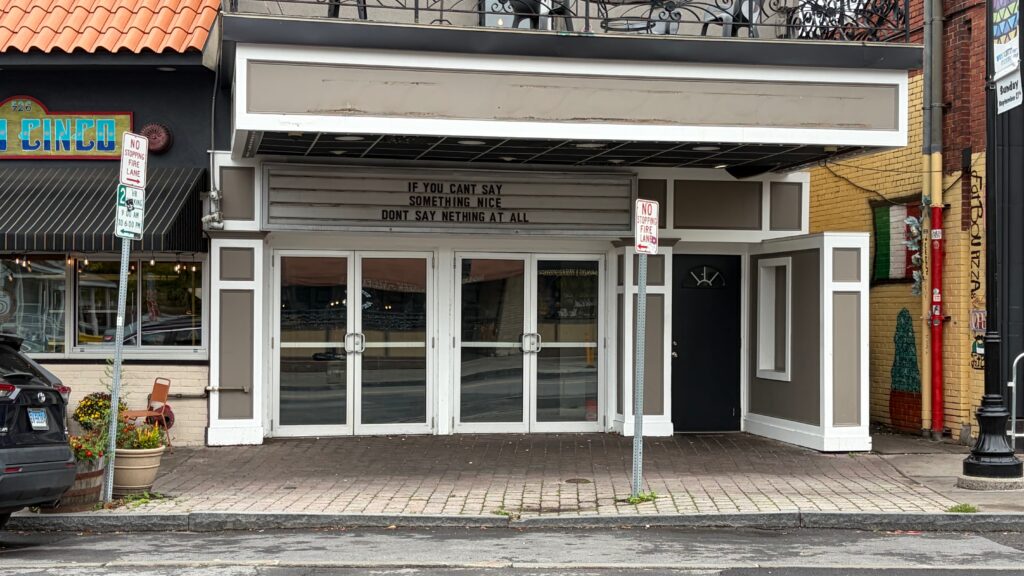
The closed doors and empty marquee of the Westcott Theater. © 2026 Jason Vandaele
SYRACUSE, N.Y. (NCC News) — Westcott residents are coming up with all sorts of ways to reopen the doors to a local landmark.
“It could become a retail venue or a church,” Sam Gruber, former president of the Westcott Neighborhood Association, said.
The Westcott Theater is celebrating its 100th anniversary. But its doors are closed. Last week, the Common Council unanimously voted to revoke the theater’s special use permit, effectively closing the venue in its current live entertainment form after 18 years, citing a recent history of violence that included fights and a stabbing.
But some residents don’t want the show to come to an end.
“A gun went off, and it hit one of the windows of the cafe that I work at,” Daniel Gavilondo, a barista at Recess Coffee, said.
He recounted a fight from a year ago that carried over to the parking lot of Recess Coffee, leading to a bullet being fired into the local cafe after hours and a wooden board being used to cover the broken glass for days.
Rita Paniagua, the Syracuse Common Council president, said the violence was damaging to the area and influenced her vote.
“This vote is not a vote against the arts or against having a theater at this location,” she said. “It is about ensuring that a venue we value also lives up to the responsibility to the community around it.”
She said she values the Westcott Theater and wants to see live entertainment remain but with changes, where the theater values the people.
“What we want in the end is a theater … where performers, patrons and residents all feel safe,” Paniagua said.
The Westcott Theater building at 524 Westcott Street was first constructed in 1919 and functioned as a cinema house for early motion pictures. It was in 1926 when it transitioned into the form residents know today, firstly as a movie theater hosting feature films and later an adult movie theater in the 70s and 80s.
“It’s gone through many iterations,” Gruber said. “Sometimes beneficial to the neighborhood, sometimes less so.”
Before the vote, Gruber, who has lived in the Westcott community for 32 years, hoped there could be a compromise to keep the theater open. Now, he said it’s time to revoke, reboot and restart.
His preference would be to go back to the 90s incarnation of an independent cinema with foreign and second-run films. But, in the age of streaming, he said he didn’t think it would be financially viable. He said his big hope lies elsewhere.
“If the proprietor of Alto Cinco was able to buy the theater or lease the theater and envelop it in that very successful business as a different type of theater, but one that still had live music,” he said.
Retaining the theater as a major draw for the whole city is important, both socially and financially, according to former SU student and longtime resident Adam Felleman. He said, if the theater doors stay closed, it will be hard to replace the spillover spending in the community.
“The theater was a part of keeping the vibrancy of our business district,” he said. “People would go to concerts and events there, would stay at local Airbnbs, they would eat at local restaurants, support our neighborhood and businesses.”
Felleman said losing an indoor 700-person capacity room, where he enjoyed live music while sheltering from the elements, will be a big hit to the music scene in Syracuse.
Moving forward, he said he wants to see greater care for the community.
“I would like to see a similar type of business that books music acts, maybe mixes it up with other types of events but one that ends at, say, midnight for the neighbors’ sake, for the volume of noise and the parking situation, to keep it not too big and crazy. Keep it going,” Felleman said.
Keeping live entertainment on the doorstep is a popular sentiment among those who support the revocation.
“I’d really love to see more plays or musicals being brought out. Syracuse University has that whole program for acting and theater. I think it would be really awesome if they could get them out here,” Alex Denton, a SUNY Upstate Medical University student, said.
For Denton, the key will be to create a space that encourages diversity and interaction between the local and academic communities such as stand-up comedy, improv and performing arts shows.
For Keegan Tyler, it should be something that makes his commute a little easier.
“I feel like they should turn it into a gay bar, so not everybody that’s this side of town have to go somewhere else to have fun,” he said.
But not everyone welcomes the change.
Concert promoter Kamar Boatman has been putting on concerts at the Westcott Theater for Black artists for more than 10 years. He said the closing will have a significant impact on the African American community.
“I’m actually heartbroken, being a lifetime resident of New York and understanding the value of basically our only concert hall that we all can have access to … for the African American artists, it’s daunting and stressful,” he said.
For Boatman, it’s another example of African Americans being treated differently and of the city not supporting businesses that cater to Black audiences. As a representative of the Minority Entertainment coalition, he said the encouragement that seeing young Black artists on a local stage gives to other members in the community will be lost, and this will impact the local economy in another way.
“Once local artists get signed, it changes the game, because now he signs his brother as his manager, his mother as his accountant. Now he’s actually building a small business right here locally in the community,” he said.
He said he doesn’t want the Westcott Theater to have a next act. He would prefer to see the existing owner, Dan Mastronardi, continue to run the theater in some capacity.
“I believe Dan deserves the right to actually still oversee something that he basically created,” he said.
Councilor Jimmy Monto has not ruled out that possibility but said concerns would need to be addressed.
“Can the operator come back to us and apply for another special use permit? Absolutely, that is an option. The parameters around it would probably look a lot different,” he said.
But, just in case, Boatman, who founded the Syracuse non-profit Curve the Curb, which focuses on educating the youth on financial literacy, sees an opportunity to use the theater as a center tailored to different community groups.
By day, a space to create for younger members of the community.
“Monday through Friday, they can come make music, build a studio in here. All types of arts,” he said.
By night, he said it could pay the bills by hosting concerts, parties and more events like the ON-RAMP graduation held at the theater in May and Mo Brown’s New York State Assembly primary election night in June.
Prior to the special use permit being revoked, Boatman said he and Mastronardi had been working on the theater’s next act.
“We were going to start doing something with the youth to try to get them to interact more, bring different sides of town [together],” he said.
But for now, those plans are on hold.
For a century, the Westcott Theater has changed with the neighborhood around it — from a movie house to a music venue. Now, with its doors closed and its future uncertain, the question isn’t whether the theater will have another act — many people want it to — but what that act will look like.
Daniel Gavilondo: There was a fight at the Westcott Theater, and it carried out over here onto Harvard Place and into the parking lot here, and a gun went off, and it hit one of the windows of the cafe that I work at there, Recess Coffee.
Jason Vandaele: The Westcott Theater is celebrating its 100th anniversary this year by closing its doors. But not by choice. On Monday, the Common Council unanimously voted to revoke the theater’s special use permit, citing a history of violence. But some residents don’t want the show to come to an end and are coming up with all sorts of ways to open the doors back up.
Sam Gruber: It could become a retail venue or a, or a church.
Vandaele: Sam Gruber is the former president of the Westcott Neighborhood Association and would like to see a return to the nineties independent cinema. But his big hope.
Gruber: You know, if the proprietor of Alto Cinco was able to buy the theater or lease the theater and envelop it in that very successful business as a different type of theater but one that still had live music.
Vandaele: While others would prefer a change from live music, to bring other interests closer to home.
Keegan Tyler: I feel like they should turn it into a gay bar, so not everybody that’s this side of town have to go somewhere else to have fun.
Vandaele: For longtime resident Adam Felleman, it will be hard to replace the spillover spending in the community if the theater doors stay closed.
Adam Felleman: People would go to concerts and events there, would stay at local Airbnbs, they would eat at local restaurants, support our neighborhood and our businesses.
Vandaele: He wants to see more variety acts at the theater but with added security and care for the community.
Felleman: But one that ends at, say, midnight for the neighbors’ sake.
Vandaele: But not everyone welcomes the news.
Kamar Boatman: Yeah, I feel heartbroken.
Vandaele: Concert promoter Kamar Boatman says closing the doors will have a big impact on Black artists.
Boatman: Basically, our only concert hall that we all could have access to.
Vandaele: The closure could leave the African American community with few places to go. But he sees an opportunity to open the doors and give young people a space to express themselves.
Boatman: Monday through Friday they can come, make music, build a studio in here. All type of arts, not just actually rapping, poetry. But then on the down side, just to create some revenue that, you know, gotta pay the bills, have events at night, that’s what I would like to see.
Vandaele: For 18 years the doors of the Westcott Theater opened to live music. Now, the question is what and who will walk through them next. Jason Vandaele, NCC News.