


VIDEO TRANSCRIPT:
CHRIS: And that was the point where I was like, dad, you have to take over my finances, you know? That’s pretty bad.
AIDAN: It’s more often than you might think. I’d say that for a lot of people. Some people they’d say like, oh, I’m not really doing it too much. And you look at your history, you’re like, wow. Like, all right. That was a lot.
JOSH: The frequency to chase bets is so much higher because of how easy it is to just click two buttons and restock your account.
ASHER: I think there’s a saying in gambling, the best thing you can do when you gamble for the first time is lose. Because if you win big, your first time gambling, like my roommate, you won big first time gambling. That’s it. You’re done. You’re hooked, you’re locked.
ELISA FLYNN: This is what most people think of when they think of gambling…a casino like Turning Stone…or a racetrack but more and more young men are turning to online betting platforms like DraftKings and FanDuel and for far too many like some of the young men you just heard from… it’s turned their college experience upside down.
CHRIS: I’m basically surrounded by it, like people like talk about like sports games and like sweating and stuff, like over games and like, I mean, I know a couple people that just like, they say they have no money, but then they always just find money to gamble.
ELISA: Chris, a student at the University of Cincinnati is just one of the thousands of college students across the country that have latched onto online sports gambling. The Newhouse Spotlight Team spoke with eight college students to find out how gambling has impacted them. One student, Aiden, who is enrolled at Syracuse University, has seen the effect of online sports gambling on campus.
AIDAN: It all starts with that first free bet. You know what I mean? Like these apps, they advertise like, you know, download now bet $5 and you get $150 worth of free bets or like up to a first a thousand dollars you lose, you get back in free bets and it’s like, okay, like I feel like there’s no way I could lose now.
ELISA: The advertising isn’t thinly veiled, either. Turn on a sports game on TV and you’re likely to see ads featuring star athletes and celebrities like Lebron James and Peyton Manning promoting online gambling. How far does this actually go? According to the NCAA, 24 percent of male and 5 percent of female student-athletes report wagering on sports within the previous 12 months, which is a strict violation of the NCAA Student Athlete Handbook. In the past year, multiple student-athletes have been caught gambling on their own teams. For instance, Texas Tech quarterback Brendan Sorsby, one of the highest-rated transfers in the 2026 cycle, recently stepped away from the team to undergo gambling addiction treatment. While playing for Indiana in 2022, he reportedly gambled on his own team to win as part of thousands of online gambling bets. Sports gambling has also been viewed as a social event.
AIDAN: Even if you’re not doing anything, you guys all get together. It feels like you’re like having a whole like party, Like, you guys are all, let’s say like, like we’ve played roulette over here. Let’s say that like everybody has black, like everybody’s arms around each other.
JESSICA MCCARTHY: And there’s that false belief that because we’re sports fans or we play sports, that we have that extra information that’s gonna make us have an advantage. Right? So that can become something that’s very common, especially among that 18 to 24-year-old age group where that brain is still developing, that reward system is high, and that risk taking gives us that extra hit of that reward system and makes it just all the more appealing to that demographic.
ELISA: Jessica McCarthy is a Team Leader at New York’s Problem Gambling Resource Center – an organization that offers support and resources for people struggling with gambling. She’s seen online gambling become increasingly more accessible through the years.
JESSICA: So generally, we have 24-7 access to apps on our phone, internet, all of those things where we can participate in all of these activities. But the thing that a lot of people don’t necessarily think about is what else we have access to on those devices, our retirement savings, our bank accounts, and things like that. So it just becomes incredibly easy for us to borrow money or use a third party app to send somebody money…”
ASHER: All you’re gonna be obsessed with is winning, winning, winning. You know, and then all of a sudden you’re losing $10, $20, a hundred dollars thousand dollars.
ELISA: What’s at stake for online gambling companies here? Billions and billions of dollars. In the Fiscal Year 2025, DraftKings reported revenues exceeding six billion dollars, a nearly 25% increase from 2024. FanDuel made almost two billion – up 17 percent from the year before. We reached out to both Draftkings and FanDuel to find out how they are protecting college-age users. Neither offered a response.
CHRIS: Winning would be awesome, but when you lose it felt terrible and then you would always want to keep going to try to chase your losses, you know…. I saw something online too, and it was like losing is twice as much – like you feel it twice as much than you do with winning, you know?
ELISA: But these significant earnings haven’t gone unnoticed. Many sports betting platforms have been taken to court over their advertising tactics, such as Baltimore suing Draftkings and Fanduel for deceptive and unfair practices in marketing, prediction market Kalshi being sued by Michigan over a Lawful Sports Betting Act violation, and even five men in Pennsylvania blaming Draftkings for enabling their gambling addictions. Many of the college students we talked to started gambling online before they turned 21 – oftentimes on offshore betting sites or through prediction markets like Kalshi or Polymarket, which circumvent the standard gambling regulations. The problem of underage sports betting has even made its way here to New York State, as Governor Kathy Hochul announced a plan to curb underage sports betting. That includes safeguards that stop minors from accessing these platforms, and measures to help those who show signs of problems in gambling.
GOVERNOR KATHY HOCHUL: And let’s do more to cut off access to online sports gaming so our kids are not ensnared by addiction at a young age. We can get that done. I know we can.
ELISA: If you or someone you know has a gambling problem, you can call the National Problem Gambling Helpline at 1-800-522-4700….
Video and digital news investigation
by Gabe Perrin, Sean Jordan, Elisa Flynn, and Ryan Lima
SYRACUSE, N.Y. (NCC News) – Gambling is now more accessible than ever before. What used to be an in-person experience at a casino now only takes the tap of a finger. Specifically, online sports gambling has gripped the minds of countless young men since its legalization in New York State in 2019. Through phone applications such as DraftKings and Fanduel, participants can wager anywhere from $1 to over $10,000. These 24/7 casinos, accessed through a phone or computer, create unlimited opportunities to make money – and even more opportunities to lose it.
Prominence of Sports Gambling among the Youth:
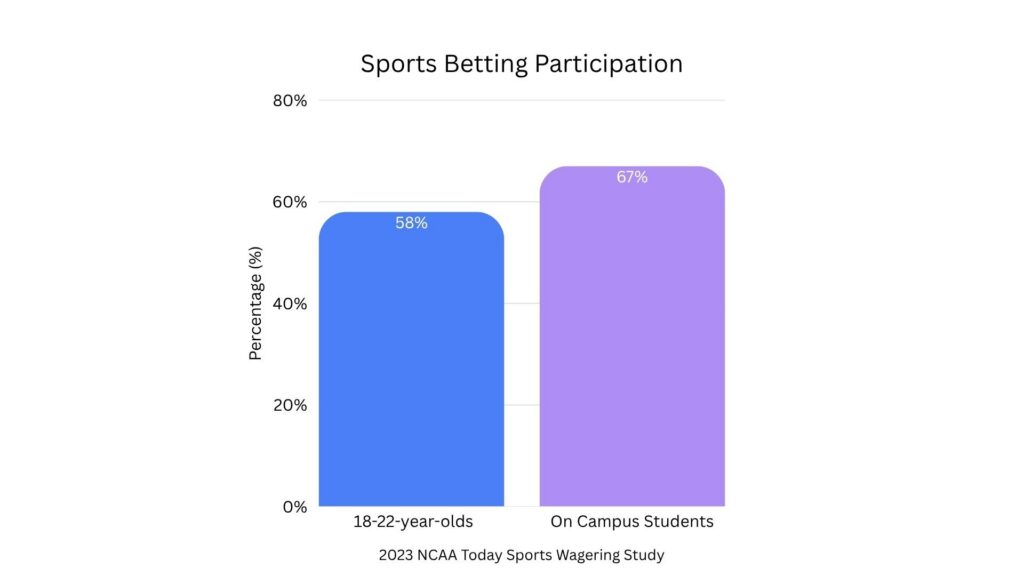
College students appear to be a casualty of online access to sports betting. According to the NCAA, 58 percent of 18- to 22-year-olds have engaged in a sports betting activity. That number jumps to 67 percent when only accounting for college students living on campus.
For young people particularly, online betting can lead to obsessive gambling behavior. A study at the University of Mississippi found that 10 percent of college students have shown signs of moderate issues in gambling, and 6 percent have tendencies of pathological gambling. This can be attributed to various factors. Betting under the influence of alcohol plays a role, as well as peer pressure and the prevalence of gambling on college campuses. With its accessibility and the opportunities to win quick money, it has become a part of college culture. Advertising tactics used by major platforms such as DraftKings and FanDuel could also play a significant role. Ads for these applications play during major sports games on ESPN, show up on Instagram and TikTok feeds and use online influencers to promote their services, making sports betting nearly impossible to ignore.
Landon, a junior at Syracuse University, says that constant advertisements nudge him to place bets.
“I’ll see lines [bets] going across the screen because they’re everywhere now on TV,” he said. “And I’ll be like, you know what, sure, why not.”
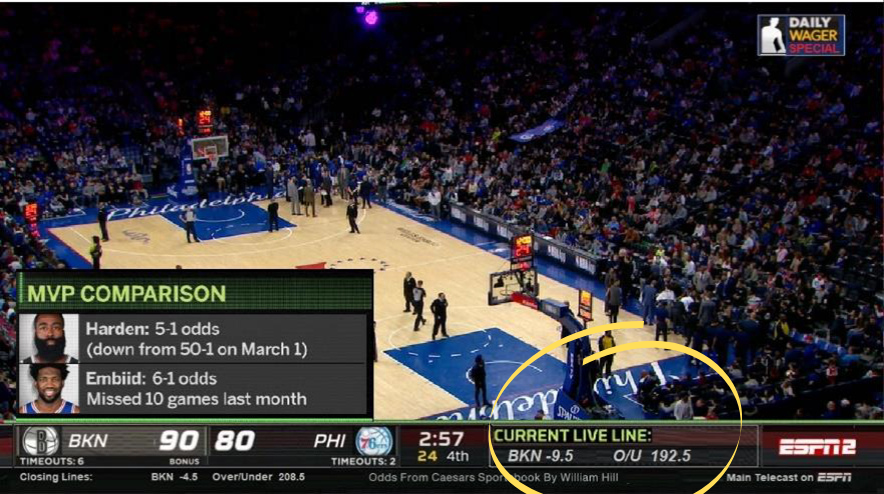
And Landon isn’t the only one. This is a common theme among young men who watch sports. For Tae, who also attends Syracuse University, he sees the gambling ads on TV and social media, and considers them a bad influence.
“Even on Instagram, or any social media, there’s a lot of influence and promotion of gambling. Especially [the] NBA is promoting FanDuel a little too much,” Tae said. “They’re just basically shoving FanDuel in front of your face. So it just increases the awareness of it, and then I think everyone just starts gambling, I guess.”
Both Landon and Tae view some of these moments as a time to bond with friends. Oftentimes, they’ll place bets in a group setting during a game, giving them a chance to root for the same outcomes together. Landon notes that he only gambles around twice a month, and Tae twice a week. Still, they are both very cognizant of sports betting’s impact on college campuses, and how it can quickly lead to destructive behavior.
Teetering Into Obsession
Take Aidan, for example. Aidan started gambling when he was 18, and currently bets on sports every day.
“I don’t know… Every time I lose, I just double the bet until I win it back,” Aidan said after being asked how much money he typically places on each bet.
His story is similar to many others, which often go underreported. Aidan says that the emotional effects of sports betting are what keep him hooked.
“It’s just like frying your brain, frying your dopamine. I swear it is, and once you don’t have it for like a few minutes, you feel something… and you can’t put a finger on it… But once it turns seven o’clock and those games are on casinos, you’re looking at your phone, you’re like, all right, what games have we got today?”
Aside from the emotional toll of gambling, young adults can lose large amounts of money–often money they don’t have. Chris, a student at the University of Cincinnati, had one experience that kept him away from constant gambling for good.
“One day I won like four and a half grand online. And then the day after I [did] this thing where I would just buy-in a hundred dollars and then just put it all in one hand… And I did that 10 times in a row and didn’t win a single hand and lost $1,000. And that was the point where I was like, ‘Dad, you gotta take over my finances, you know?”
Lawsuits
With its rapid rise, states have tried to highlight these issues through lawsuits. The city of Baltimore sued DraftKings and FanDuel over misleading tactics, claiming that they engaged in unfair and deceptive practices to market their platforms. The state of Massachusetts did the same, and Pennsylvania even included the NFL in a lawsuit where they claimed the league is aware of their marketing of a “known, addictive product.”
Users of these platforms also experience significant in-app tactics, be it through notifications or targeted “bonus bets” that incentivize high user deposits to receive more money. This concept was brought to court in Connecticut, due to complaints of users being misled. DraftKings settled to return over 3 million dollars to people affected by it. Despite the loss, the platform still utilizes these promotions, and it’s actually one of the main drivers for new users to join the platform.
DraftKings has supported responsible gambling through its DraftKings responsible gaming center and partnered with the National Council on Problem Gambling. FanDuel has taken similar actions and partnered with colleges and universities about gambling awareness and funded responsible gambling campaigns and educational outreach.
Expert Opinion
The bombardment of advertisements throughout all mediums of the internet, TV included, impacts younger students in a different manner than it does to fully developed adults. Rebecca Cooper, the head of the gambling division at OASAS, says that the impressionability of people under 25 directly influences the marketing of these apps.
“The younger someone starts gambling, the more likely they are to develop a problem,” Cooper said. “And 18 to 24-year-olds, that age bracket tends to be at high risk for developing and potentially having harms related to gambling.”
What Next?
Some government officials are already taking action, including here in New York. Governor Kathy Hochul outlined the issue in her 2026 State of the State, and went into greater detail in a late March press release, where she says she plans on introducing safeguards to stop minors from accessing these platforms, and introducing measures to assist those who show signs of gambling problems.
“Mobile sports wagering is everywhere, enticing everyone — including our youth — to place bets without fully considering the consequences,” Hochul said. “We need strong regulatory safeguards to prevent those under 21 from gambling, keep artificial intelligence from preying on gamblers, and require sports wagering operators take real action if one of their customers is showing signs of gambling harm.”
Initiatives like Hochul’s will need to act quickly, as sports betting is becoming an ever-evolving industry that will only continue to attract younger audiences without proper regulation. Syracuse University student Asher that winning may not be the best thing to do on these apps.
“There’s a saying in gambling, the best thing you can do when you gamble for the first time is lose,” Asher said. “Because if you win big, that’s it, you’re done. You’re hooked, you’re locked. What are you gonna do?”