

SYRACUSE, N.Y. (NCC News) –– Faith leaders in Syracuse said connection is vital as immigration enforcement efforts intensify nationwide, prompting conversations across religious communities about how to support people facing fear and uncertainty.
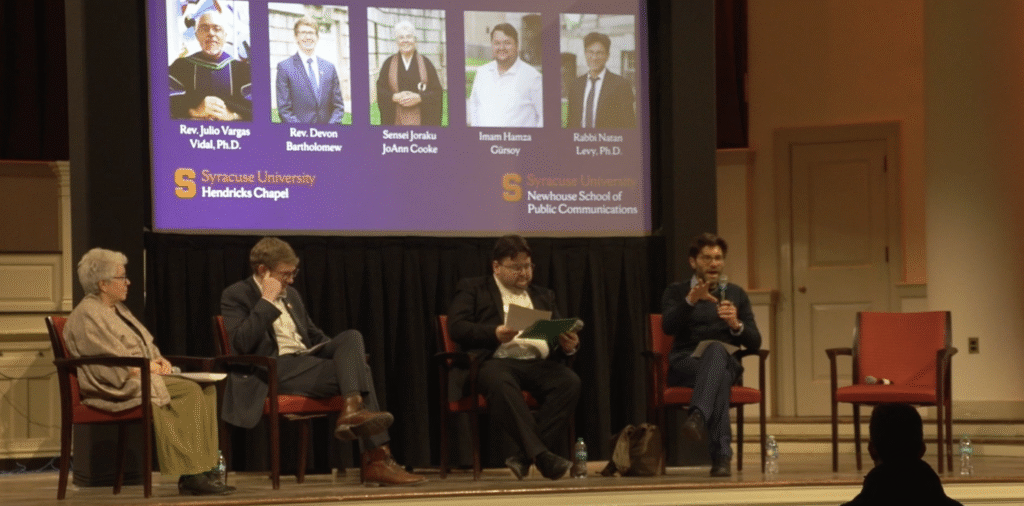
Clergy and chaplains from several traditions gathered at Hendricks Chapel this week to discuss how faith can guide people through instability, and what action can look like beyond prayer.
The conversation comes as local faith leaders reflect on what they are seeing beyond Central New York.
Rev. Jo Vonrue of May Memorial Unitarian Universalist Church recently returned from Minneapolis, where she joined protests and community response efforts tied to immigration enforcement.
“There’s so much hope…yes, the world is on fire, and all of these people are taking care of themselves in the most extraordinary ways I’ve never seen. And, we haven’t built that network yet because we haven’t needed it,” Vonrue said.
She said she witnessed neighbors stepping in to support families facing detention and separation, often in deeply personal ways.
“One organizer showed up late to a meeting because she was delivering breast milk to help feed a baby whose mother had been taken from the hospital,” Vonrue said. “People are stepping into parental roles for strangers. It shows how communities create care when systems fail.”
Even though Central New York has not experienced immigration enforcement on that scale, Vonrue said what she witnessed in Minneapolis highlighted the need to build stronger local support networks before crises unfold.
At Hendricks Chapel, faith leaders discussed how various spiritual traditions shape their response to immigration and uncertainty.
Buddhist Sensei Joanne Cook said peace requires consistent effort from individuals and communities.
“Peace is a practice. Not a hope. It’s important to realize that we do have everything we need to make a change.”
Cook said mindfulness helps people stay grounded during divisive conversations and recognize shared humanity.
“Being aware of your reactions and finding oneness with people who are different from you is key,” Cook said.
Protestant Chaplain Devon Bartholomew of Syracuse University said Christian teachings about loving one’s neighbor call for compassion even when it feels uncomfortable.
“Loving your neighbor means recognizing someone else’s dignity,” Bartholomew said. “It’s important to be slow to speak and quick to listen when differences arise.”
Islamic Chaplain Imam Hamza Gürsoy expressed a similar message from the Muslim perspective, saying that respect across religious, cultural and racial differences is central to building stronger communities.
Not all leaders agreed on how faith communities should respond publicly to immigration enforcement.
Evangelical Pastor Julio Vargas Vidal said religious guidance should remain grounded in prayer and respect for the law.
“We are not called to break any laws. We are just called to listen. And according to prayer,” said Vidal.
Despite differing perspectives, faith leaders shared a common message: building connections across communities is critical during times of uncertainty.
At the interfaith event at Hendrick’s Chapel, faith leaders said uncertainty often tests spiritual values in real time, forcing communities to decide whether compassion remains theological or becomes action.