

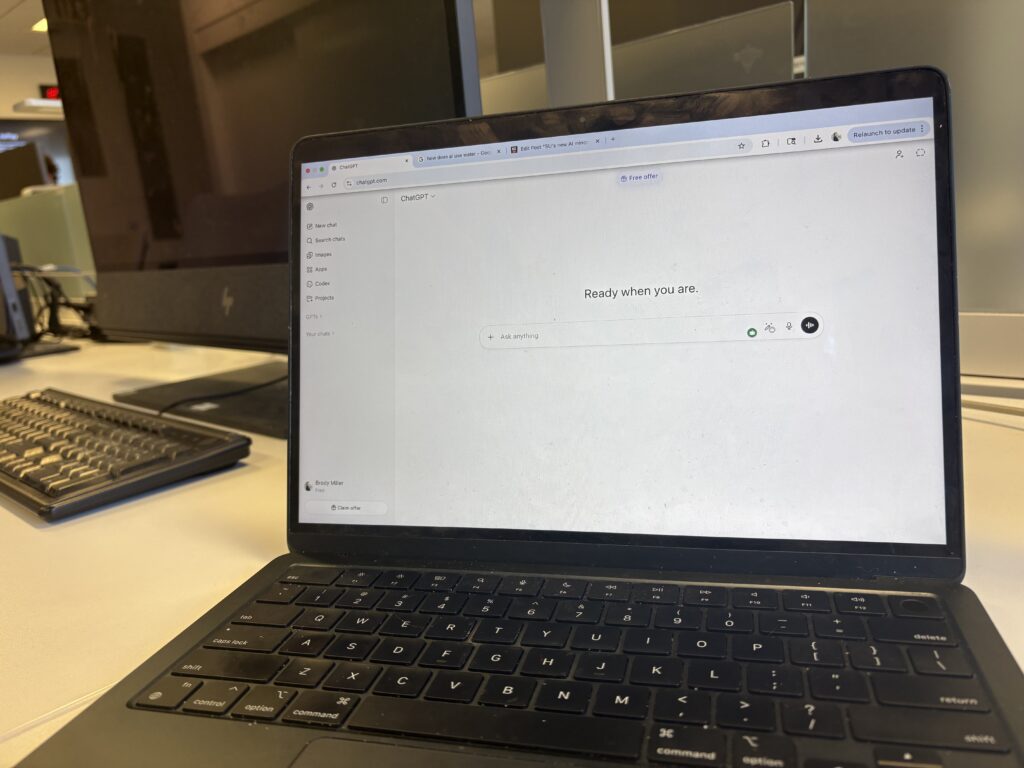
SYRACUSE, N.Y. (NCC News) — Just over two weeks ago, Syracuse University’s College of Engineering and Computer Science introduced a new minor in artificial intelligence. But as generative AI tools make their way into almost every aspect of daily life, including classrooms at Syracuse University, the future environmental consequences of programs like this have largely gone undiscussed.
Saman Kumarawadu, a professor in the College of Engineering and Computer Science at SU, said his AI teachings focus on ethically complementing current practices.
“We have to educate all of the stakeholders who are involved with building AI systems to make sure that we have ethical considerations. For example, there’s a security aspect of AI development and the usage of AI, and then how we can handle those privacy issues,” Kumarawadu said.
AI tools such as ChatGPT are fueled by data centers across the country. These centers use hydropowered cooling systems in order to stop servers from overheating.
As AI use increases, so does the depletion of these natural water sources. According to research done by the University of California, Riverside, generating a 200-word response from ChatGPT uses about 35 ounces of water. This has sparked discussion among students across universities, including SUNY ESF.
ESF junior Lydia McFarland believes students should consider turning to existing campus resources before reaching for AI tools.
“I think that we should be using the resources that the college gives us, like the academic success center,” McFarland said.
“All of those resources are already there for us without providing significant and extra environmental harm.”
Kumarawadu said that eliminating AI is not the solution for saving the environment. However, being more mindful of what you are inputting into these tools is the real energy minimizer.
“Be very mindful of how we are going to optimize our input to the model or the generative AI system to minimize the amount of energy the models are going to use,” Kumarawadu said.
More information on AI courses taught at SU, including those in Maxwell, iSchool, and ECS can be found on their respective websites.