

SYRACUSE, N.Y. (NCC News) — A group in Syracuse is keeping history alive while providing a welcoming place for all.
Salt City Historical Fencing is a historical fencing group based in Syracuse. The group is one of hundreds across the country that practice historical European martial arts, known as HEMA.
The sport is similar to fencing but focuses on the study of historical combat styles rather than a standardized Olympic sport. People around the world practice it, and the number of active clubs has surpassed 1,800 globally, according to data from the HEMA Alliance and the HEMA Ratings databases. That figure includes competitive schools and informal study groups, with tournaments and meets bringing participants together.
Rune McCabe co-founded the Syracuse club in 2022 after moving to the region. They noticed there wasn’t an active HEMA group in Syracuse, so they decided to start one.
“When I moved up here, it was kind of barren,” McCabe said. “There was one club that had been defunct for a while that we could never get a hold of.”
McCabe said the sport has gained a small following in the queer community.
“I think queer people like swords,” McCabe said. “I genuinely think there is something to be said for a lot of people’s upbringings, where they have grown up with a particular aesthetic — like me.”
McCabe said about a third of their old gym was part of the LGBTQIA+ community, with the instructor being a transgender woman. With both instructors at Salt City Historical Fencing identifying as nonbinary, the club makes it a point to be as inclusive as possible.
“We just like to make sure that’s really included,” McCabe said. “We try to promote it as an open and welcoming place for anyone, from any particular group.”
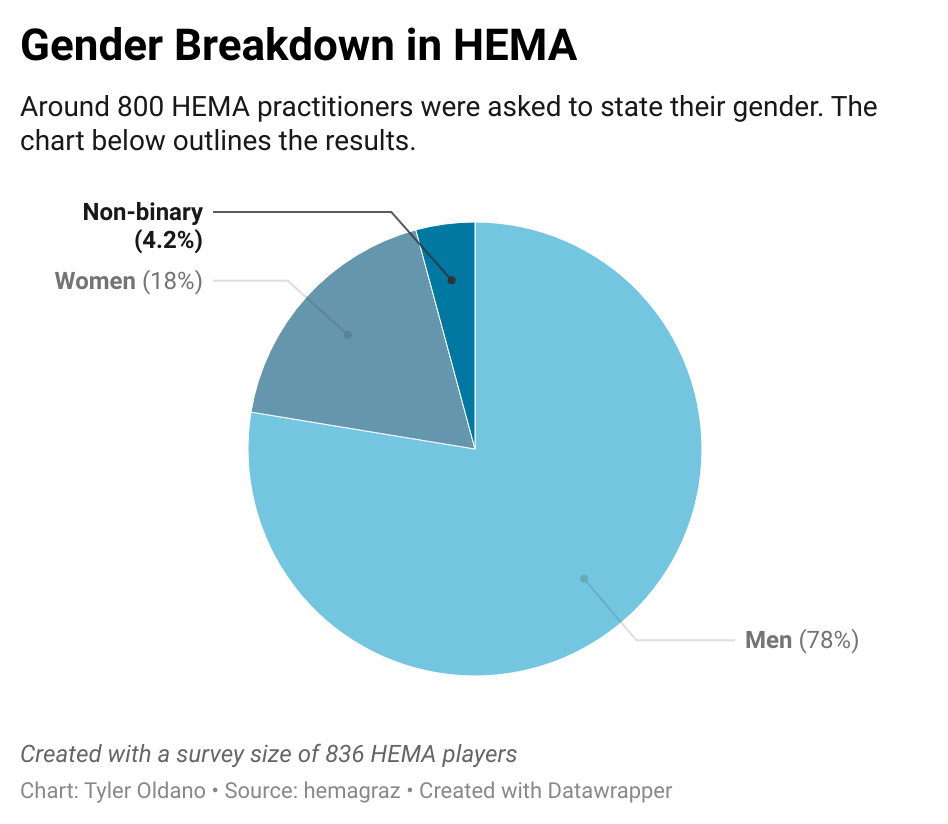
While data on queer participation in HEMA is limited, a survey conducted by HEMA Graz of more than 800 practitioners found that about 4% identified as nonbinary. Although the sport is still male-dominated, the number of nonbinary participants identified in the survey is disproportionately higher than their presence in the general population, according to a Gallup poll that found about 1% of U.S. adults identify as nonbinary.
McCabe said the physical exercise is part of what draws them to the sport. But Dylan Fifield, another practitioner, said he stays for the historical aspects. A vital part of learning involves studying and interpreting classical sword-fighting manuscripts.
“All the different movements and stances we practice, you see directly in the manuscripts as well,” Fifield said.
Fifield took up the sport four months ago when he was looking for something to do in the local area. Now he practices as much as he can, saying the sport “just has this draw to it.”
“It’s almost like the sword becomes an extension of yourself. I feel myself improving every day,” Fifield said.
Fifield doesn’t yet own a sword, as a good-quality blade can cost several hundred dollars. Still, he keeps his skills sharp at home, using a broom to practice his drills.
Both Fifield and McCabe say they put significant effort into their training. McCabe said they plan to continue the sport for as long as their knees will allow.
For more information on how to get involved or to find a club near you, visit hemaalliance.com.
VIDEO TRANSCRIPT: Swords in Syracuse
Tyler Oldano: From broadswords to foam swords, the Salt City Historical Fencing Group brings bladed combat from 1452 Europe to 2025 Syracuse.
Rune McCabe: “Block”
Clang
Rune McCabe: “Yeah!”
Oldano: Rune McCabe is one of the group’s founding members, and they say picking up the steel just made sense.
McCabe: “I grew up with a ton of different media that depicted, you know…knights. Legend of Zelda has all sorts of sword fighting and stuff in it, and that’s been my bread and butter since I grew up. So it was just kind of a natural fit where I just immediately wanted to be like, ‘I want to hold a sword’ and ‘I want to hit things. ‘“
Oldano: While McCabe has been practicing for more than 10 years, Dylan Fifield, one of the club’s newest members, is going on about 4 months of practice. But he says he’s getting better every week.
Dylan Fifield: “I’d say I’m still, like, very much a beginner at all this and but still, you know, I still feel myself improving every single day or every single time I come here.”
Oldano: “But being good at Hema is more than just studying the blade. It’s also about studying the book as well.”
McCabe: “There are a lot of treatises, a lot of manuscripts, a lot of different weapons that you can pick up and put down, and there are a lot of different blueprints, a lot of different things about that.”
Oldano: And even though it’s a very physical sport, Fifield and McCabe both tell me they can’t envision giving it up.
McCabe: “Good thrust!”
Oldano: Reporting for NCC News, I’m Tyler Oldano.