

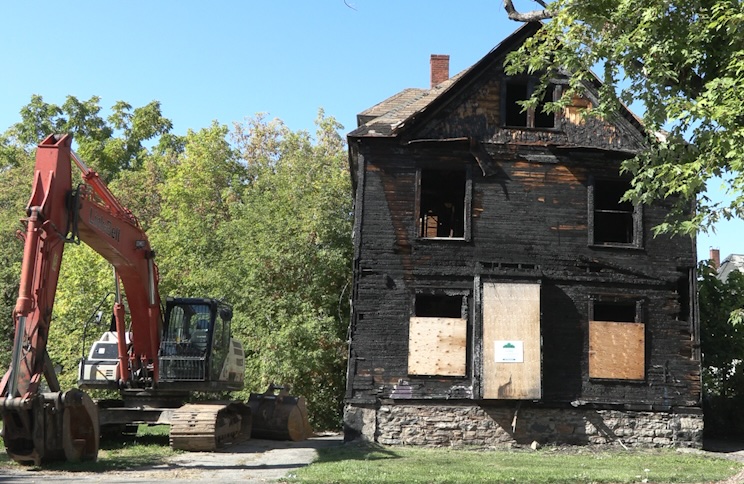
SYRACUSE, N.Y. (NCC News) — Thousands of property owners in Syracuse have fallen behind on their taxes, putting their properties at risk of foreclosure and their tenants at risk of displacement.
The pandemic and recent changes in state tax law have created a foreclosure backlog of around 2,000 properties, according to the Greater Syracuse Land Bank. That backlog could impact redevelopment initiatives aimed at creating affordable housing in neighborhoods that need it most.
According to a housing plan released by the mayor’s office, Syracuse faces competing pressures. Population growth for the first time in decades, the planned removal of the I-81 viaduct, downtown housing expansion and Micron’s regional plans have all increased housing demand. At the same time, the city struggles with high numbers of cost-burdened households, concentrations of poverty, deteriorating housing conditions and rising prices.
Foreclosed properties are processed by the city. If there is no response from owners, properties are eventually sent to the Greater Syracuse Property Development Corporation, also known as the Greater Syracuse Land Bank, following Common Council approval.
The organization was established by the city in 2012 to acquire and redevelop vacant and abandoned properties. Since then, it has overseen about 700 demolitions and sold more than 1,400 properties. The number of vacant buildings in Syracuse has declined by about 44 percent.
Vacant and abandoned units are not just wasteful – they also pose safety concerns. The Syracuse City Auditor’s analysis of structural fires in 2024 found that nearly 30 percent of the 87 incidents occurred in units determined to be vacant. Responses to these fires, including fire personnel and cleanup efforts, cost an average of $1.27 million per incident.
Land Bank Executive Director Katelyn Wright said the organization focuses on vacant and abandoned structures to meet its goal of 100 new affordable housing units per year.
“I would love to see that number get higher, but it’s all dependent on how much funding can flow in from New York State,” Wright said. “New York State is providing more funding than ever before for affordable housing development and we just want to be in a position to take advantage of those funding opportunities.”
State redevelopment funding depends on the Land Bank having enough properties in its portfolio. That requirement could become an issue as delays caused by the pandemic continue to slow foreclosure processes.
“We’re shifting our focus toward vacant land because we need to have this portfolio of options available for housing development,” Wright said. “We want to make sure that we’re prepared for next year as well.”
Syracuse resident Mallory Chilluffo said she hopes redevelopment will bring more affordable options and revitalize struggling areas.
“I would like to see more affordable housing, more businesses like local restaurants, shops,” Chilluffo said. “It would be nice to see our downtown area thriving.”
In Syracuse, empty lots and burned-out homes are visible reminders of the thousands of tax-delinquent properties the city has yet to process. City leaders hope to redevelop these properties to address a growing need for affordable housing and to revitalize struggling neighborhoods.
VIDEO TRANSCRIPT: Foreclosed Syracuse properties are a chance to redevelop where it’s needed most
Natalia Davidson, Reporter: Thousands of Syracuse properties are at risk of foreclosure.
Allistar Cameron, Syracuse Resident: I don’t know why these are empty lots, but hopefully there will be development.
Davidson: The pandemic and recent changes in state tax law have left a foreclosure back log of around 2,000 properties, a back log that the Greater Syracuse Land Bank says could impact redevelopment initiatives.
Katelyn Wright, Greater Syracuse Land Bank Executive Director: New York State is providing more funding than ever before for affordable housing development and we just want to be in a position to take advantage of those funding opportunities.
Davidson: The Syracuse Audit Office found that of the 87 structural fires that occurred last year, nearly 30% of those occurred in vacated structures like this one, some of which have owners who haven’t paid water bills or property taxes in decades. Now, this ends up costing Syracuse taxpayers nearly $1.27 million per incident.
Wright: We’re shifting our focus toward vacant land because we need to have this portfolio of options available for housing development
Davidson: Since the land bank’s founding 13 years ago, Syracuse has seen a 44%decline in vacant properties, but affordable housing is still an issue.
Mallory Chilluffo, Syracuse Resident: It’s kind of crazy how expensive rent is in a city like Syracuse.
Davidson: The mayor’s office released a housing plan earlier this year that blames population growth, planned infrastructure projects, and Micron’s expansion in the region for increased prices.
Kenny Escobar, Syracuse Resident: Syracuse is in a rebuilding phase so that’s an opportunity right there.