

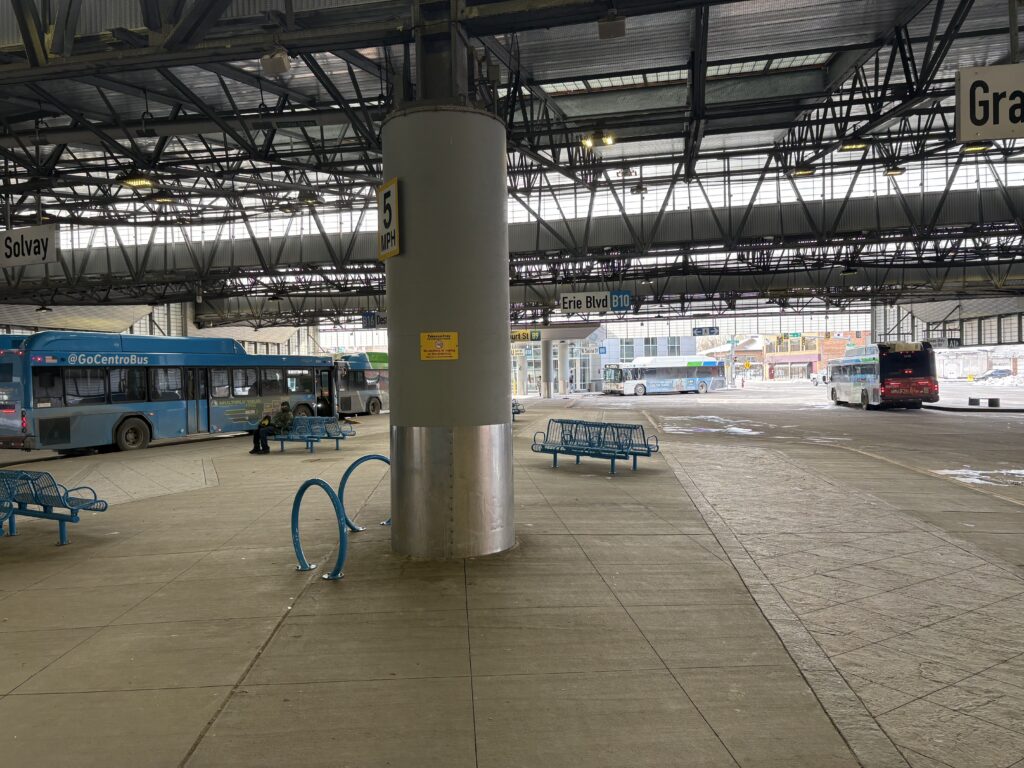
SYRACUSE, N.Y. (NCC NEWS) — Centro is nearing the final stage of a sweeping redesign of its bus system, a plan that could reshape how thousands of people get around Onondaga County.
The effort, nearly two years in the making, marks the first full overhaul of the system in more than 20 years. Transit officials say the current network no longer fits how people travel today.
“It’s been a while, more than 20 years since we’ve done a full redesign of our system,” said Bren Daiss, Centro’s associate vice president of communications and business planning.
At the center of the plan is a shift in priorities. Centro wants to simplify routes and run buses more often in high-demand areas like Syracuse, where ridership is strongest. The goal is to have fewer, more direct lines and shorter wait times for many riders.
Centro officials say that change responds to long-standing complaints.
“One of the things that we’ve heard from the public over the years is that our schedules are confusing,” Daiss said. “How can we make this easier for the customer to understand? How can we make it easier to navigate?”
The redesign would also change how buses move across the system. Some routes will no longer pass through Centro’s downtown hub, instead taking more direct paths between neighborhoods.
“Not everybody wanted to go to the hub for every trip,” Daiss said. “There are four or five routes that are not scheduled to go into the hub at all.”
Another key change: fewer stops. In some parts of the city, buses currently stop nearly every block. Under the proposal, stops would be spaced farther apart to speed up service.
“If you had to walk two blocks instead of one block,” Daiss said. “We can go faster without having to stop at every block.”
For transit experts, those changes reflect a broader shift happening across the country.
“It’s long overdue is the short of it,” said Austin Zwick, a Syracuse University professor who studies urban planning and transit systems. “What they’re doing is the textbook route updating.”
Zwick said transit systems often face a trade-off between coverage and frequency. Older systems tried to reach as many places as possible, even if buses came infrequently. Newer approaches focus on running buses more often where demand is highest.
“The problem becomes when a bus only comes every 45 minutes or an hour and a half—how usable is that bus really?” Zwick said.
He said increasing frequency can make transit more reliable and more appealing to riders.
“There’s a saying in transit planning that frequency is freedom,” Zwick said. “That’s really what Centro is going for here.”
But that shift comes with clear tradeoffs — and not all riders are convinced it’s the right move.
“I don’t think that is helpful. That is not really accessible,” said Bee Browns-Parks, a Syracuse bus rider. “I don’t think it’s necessarily a problem that there are a lot of stops.”
Browns-Parks said fewer stops could make it harder for people with mobility challenges or limited access to transportation to reach bus lines, even if service is faster once they get there.
The divide highlights a central tension in the redesign: improving efficiency while maintaining accessibility.
In suburban and lower-density areas, that tension becomes even more clear. Some routes could be reduced or eliminated altogether. In their place, Centro is proposing an on-demand service called MOVE.
The system would allow riders to request trips through an app or by phone, with smaller vehicles picking them up and either taking them to their destination or connecting them to a main bus route.
“It’s kind of like Uber bus,” Daiss said.
Zwick said on-demand service is often used to fill gaps in areas where traditional bus routes are too costly to run.
“It’s a lot more affordable to send a van to those areas and pick those people up,” he said.
Still, he acknowledged the downside.
“The downside of picking this strategy is that you’re decreasing service for the areas that are losing coverage,” Zwick said. “The question is how do you continue to provide services to them?”
Centro officials say they have tried to balance those concerns through months of public outreach—and by adjusting the plan in response to feedback.
In Fayetteville, for example, the agency restored direct bus service to Towne Center after riders objected to an earlier proposal that would have left the shopping area more than two miles from the nearest stop. Service was also added back in parts of Camillus and adjusted in neighborhoods like Eastwood.
“That was great feedback and something that we could absolutely change based on what the customers wanted,” Daiss said.
Even so, some reductions remain under consideration, particularly in areas with lower ridership.
Centro plans to hold a final public hearing on April 23 at 5 p.m. at the Inspire Innovation Hub, 235 Harrison St., before its board votes on the proposal in May. If approved, the new system would roll out in May 2027, Daiss said.
For now, the debate reflects a broader question facing transit systems nationwide: whether it’s better to serve more people more often — or serve more places less frequently.
For riders like Browns-Parks, the answer is clear.
“True accessibility means active and frequent bus fare in everywhere that a bus can get to,” Browns-Parks said.