

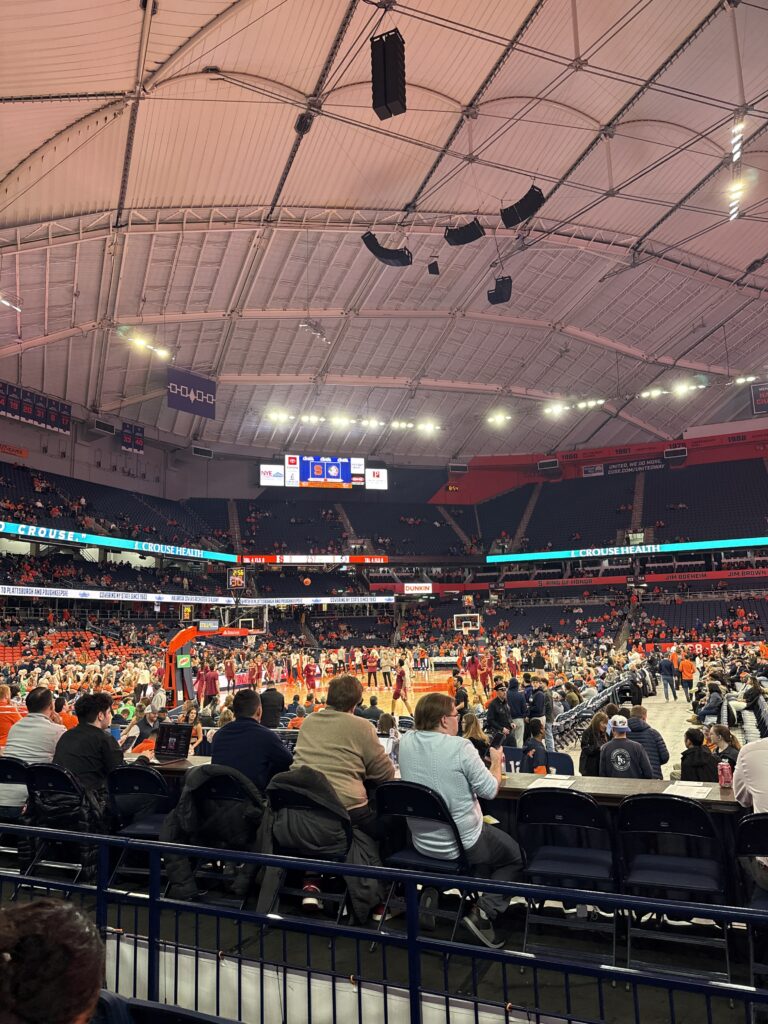
SYRACUSE, N.Y. (NCC News) — The JMA Wireless Dome, formerly known as the Carrier Dome, has been the home of Syracuse football, lacrosse and basketball since 1980. To this day, it remains one of the most unique college sports venues in the country and Syracuse is both the only school in the nation that plays basketball and football games on the same field, and the only Division 1 basketball school that doesn’t play its home games in a facility made specifically for basketball.
Along with being an instantly-recognizable venue, the Dome has unmatched fan capacity for basketball games. Since it opened, the men’s team has led the ACC in average attendance 16 times. Over 35,000 fans can pack the Dome for a single game, making it the highest capacity college basketball venue in the country by over 10,000 seats.
For Syracuse, maximizing home court advantage means packing as many people as possible into the crowd and allowing 35,000 fans to sound like 100,000. However, the stadium must be half empty for basketball games, and the huge open space causes issues when there aren’t 35,000 people in attendance.
The space is hardly an issue when at capacity, but when attendance gets low, the difference is noticeable. JMA Wireless Dome head audio technician David Beckert said he and his team compensate with the stadium speakers when there are more empty seats than people.
“You can definitely hear the difference,” said Beickert. “We really try and manage the volume in that regard, and one of the ways we do that is with music.”
The data shows that size of venue majorly impacts how loud the Dome gets, even at capacity.
Cameron Indoor Stadium, home of Syracuse’s rival Duke, has a noise record of 121 decibels, achieved by just over 9,300 fans.
Syracuse’s record is 120 decibels, set in 2005 by over 30,000 fans.
So, what helps make 10,000 people just as loud as 30,000? At Duke, the location of the student section is a big reason.
Duke moved their student section to surround the court in the 1980s as coach Mike Krzyzewski built it into the program it is today. The result is having the court surrounded by 1,700 of the loudest fans in the building, allowing the students to create a famously hostile environment and making Cameron Indoor one of the most feared arenas in the country.
Another school that switched to a court side student section is Michigan State University. Breslin Center has been a feared basketball venue for decades, and the student section, nicknamed the “Izzone,” takes up half of the lower bowl of the arena.
The location of the Izzone is a big part of why many players say that MSU is one of the hardest places to play in the country. However, Breslin has a total capacity of under 15,000, another example of achieving a raucous environment by maximizing lower fan capacity with sound-conscious stadium design.
Syracuse students themselves have also shown an interest in being closer to the court. Sophomore Henry Fines thinks there are more benefits of moving the student section than drawbacks.
“I’ve been at close games at the dome, and it does get so loud,” said Fines. “Moving the students feels like similar to what the LA Clippers just did with the wall of fans behind the net. When other teams are shooting free throws, you want fans next to the court making as much noise as possible.”
So, why not follow suit with other highly competitive schools and put the students around the court? Beickert said part of the issue would be reliance on a high number of students to fill the space at every game.
“I think that we’ve largely kept the students where they are because (the Dome) is so large,” said Beickert. “We can fit so many people, and the student body that shows up to games is a variable number. Cameron Indoor is different because it is so small, you can always rely on 1,000-2,000 people showing up, and that’s all you need. Here, we can get 1,000, or we can get 5,000.”
Planning a student section for 1,000 is a lot different than planning one for 5,000. Surrounding the court at the Dome with students would likely create a more intense court-level environment, but one that would rely on a certain amount of students at every game. The seats in the Dome are situated so that surrounding the court with students would require many more than a place like Cameron would, and that high of attendance is unreliable.
Syracuse men’s basketball has been having a rough season. A 6-8 record in ACC play along with tournament hopes already being dashed doesn’t motivate the fan turnout that Syracuse needs to get full home court advantage.
The season combined with the space next to the court and without full capacity at most games, it has been difficult for fans to keep the “loud house” a hostile environment recently. It gets much easier to point out how the space behind the bleachers affects sound when the stadium is under half capacity because it is only offset when the Dome is full.
Playing basketball on a football field is unique, and even with some drawbacks, it allows Syracuse to accommodate more fans than anywhere in the country when Syracuse basketball gets hot.
The Dome is designed for high energy basketball games, and Syracuse made a choice between a smaller arena with a more consistent environment and the highest-capacity college basketball venue in the country with a less consistent environment.